Green and Blue Bouclé Yarn for Hand Knitting and Machine Weaving
What Is Green and Blue Bouclé Fancy Yarn?
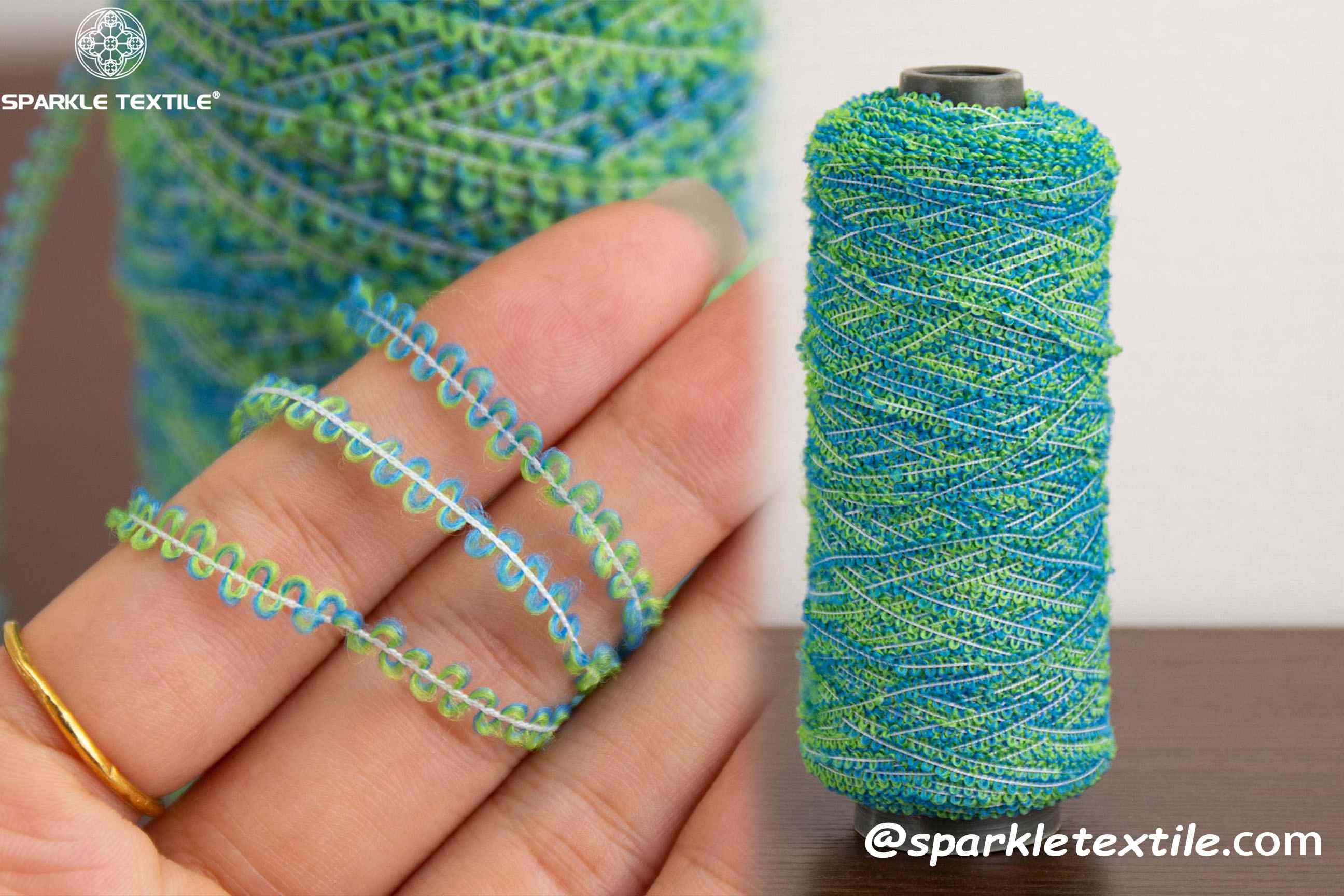
On the cone, this yarn reads as a blend of bright blue and lime green. Pull out a single strand and the construction comes into view. Small, rounded loops run along a fine, pale center thread. The loops give the yarn its raised bouclé texture, while the way the two colors overlap creates subtle shifts in tone. In a finished swatch, those details can read as a fine texture from a distance and as distinct loops up close.
Sparkle Textile offers this green and blue bouclé fancy yarn for hand knitting and machine weaving. It gives fabric mills, knitwear developers, and yarn distributors a way to introduce color and surface texture in the same yarn. The loops can cover a panel, form a narrow stripe, or appear at intervals across a woven ground. How much color and texture come through depends on how the yarn is used in the fabric.
A Two-Tone Loop Structure With a Visible Center Thread
The bright blue brings a cool tone, and the lime green adds contrast. In the close-up, both colors can be seen within short sections of the strand, with a fine, pale thread tracing the center. That detail gives the yarn a clear outline when it is used as an accent and creates scattered lighter lines when several strands are worked close together.
The cone gives a first impression of the overall palette. The fabric sample shows how that palette actually reads in a chosen construction. A pale ground can make the loops easier to distinguish, while a darker ground can bring out the brighter green and blue. A solid blue base can pull the finished fabric toward the cooler side of the palette, while a green base emphasizes the lime tones. For a color approval, compare finished swatches on the intended ground under the same lighting.
The yarn has a soft hand, and the loops add surface dimension. The ground yarn, stitch or weave density, and finishing process all influence the hand and drape of the finished fabric. A narrow accent on a firm ground can hold a defined line.
Hand Knitting With Green and Blue Bouclé Yarn
For hand-knit scarves, shawls, and garment panels, a simple stitch pattern gives the two-tone loops room to show. Start with a plain swatch to see how the loops settle into the stitches and how the colors distribute across a few rows. Then compare it with a swatch that uses the bouclé in a single stripe or in several spaced rows over a smooth companion yarn.
A short band can frame a cuff, hem, or neckline. A wider panel can bring more color to the front of a vest or along the ends of a scarf. Holding the bouclé with a smooth companion yarn is another option to sample. The companion yarn changes the background color and the density of the fabric, so compare swatches with and without the extra strand before choosing a stitch and gauge.
As you knit, take a moment to identify the main strand when picking up a stitch. The small loops can blend into the stitch outline, especially in a dense swatch. Working a small sample first makes it easier to see how the yarn sits in the stitches and how much texture remains visible after the intended finishing process.
Machine Weaving With Bouclé as an Effect Weft
For woven fabric development, using the bouclé as an effect weft over a smooth warp is a practical starting point. This lets the mill keep its ground construction consistent while comparing how often the loops appear across the fabric. Try widely spaced bouclé picks for fine lines of color, then group several picks together to see how the same yarn reads as a more prominent band.
The cone is evenly wound for yarn feeding. In a loom trial, check how the loops pass through the guides, how consistently the yarn feeds, and how the loops look on the face of the cloth. Compare a few weft densities with the same warp and ground weft. That comparison makes it easier to see whether the loops sit visibly on the surface or are drawn into the fabric as the weave becomes tighter.
Look at the sample again after finishing. Compare the face and reverse, the visibility of the blue and green, and the drape of the cloth. For applications such as jacket panels, woven accessories, or decorative fabrics, assess snagging and pilling against the requirements of the finished item. For fabric that will be cut and sewn, include a stitched seam in the trial to see how the loops sit along the join.
Design Ideas for Apparel, Accessories, and Fabric Collections
Contrast Panels for Knitwear
Use a blue-green panel on the front of a vest or cardigan and carry one of its colors into the rest of the garment with a smooth yarn. A plain ground lets the panel stand out, while a matching blue or green can make the transition softer. For a smaller accent, sample the bouclé at the pocket edge or along the sleeve above the cuff.
Textured Stripes for Woven Fashion Fabrics
Use isolated picks for narrow lines or repeat wider bands across a solid ground. A mill can show several layouts on one swatch with a consistent warp, then choose the repeat that works best at garment scale.
Borders for Scarves and Decorative Textiles
A bouclé band at each end of a scarf keeps the center visually open and draws attention to the ends when the scarf is worn. The same approach can define the border of a decorative textile or form a narrow stripe on a cushion front. Sample the fold or seam where the textured section meets the ground to see how both yarns sit together.
What to Check Before Approving a Sample
Decide where you want the loops to appear in the finished piece. For all-over texture, inspect an area large enough to show how both colors distribute. For stripes or borders, work the full repeat or border width so you can judge the transition between the textured section and the ground. View the swatch at the distance a buyer would see the finished garment or textile, then check the loop detail up close.
Use the same ground yarn and finishing process across your first round of swatches so you can compare how changes in stitch density, pick spacing, or coverage affect the result. Record the construction and settings alongside each sample so the selected effect can be reproduced at the next stage of development.
For a sourcing inquiry, share your end use, whether you plan to hand knit or machine weave the yarn, your target yarn count if known, and a reference for the look you want. If you are developing a woven fabric, a ground swatch or a photo of the intended construction helps show where the effect yarn will sit. For a color development, include a physical reference if exact matching is important to the collection.
Frequently Asked Questions
Can I request a different shade combination or yarn count?
Sparkle Textile can discuss custom color combinations and yarn counts for this loop fancy yarn. Share your target shades, count, intended application, and estimated quantity so we can review the options for your project. Small-batch sample orders are supported for textile development.
What details can I confirm when requesting a sample?
Ask for the applicable fiber composition, yarn count, cone packing, and sample lead time for your requested version. Include your process and anticipated order quantity if you also need a bulk quotation. For machine weaving, a trial on your intended setup allows you to assess feeding, loop visibility, and the finished fabric before scaling up.
Request a Green and Blue Bouclé Yarn Sample
If you are developing a hand-knit accessory, a textured knitwear panel, or a woven fabric with a two-tone accent, tell us where you want the loops to appear and how much surface you want them to cover. Share a sketch, a reference swatch, or your target yarn count with Sparkle Textile. We can review your requirements and discuss sampling, custom colors, and a wholesale quote.
Website — www.sparkletextile.com
Email — info@sparkletextile.com
WhatsApp — +86 137 3899 0393